
Options Greeks Masterclass: Delta, Gamma, Theta & Vega Explained
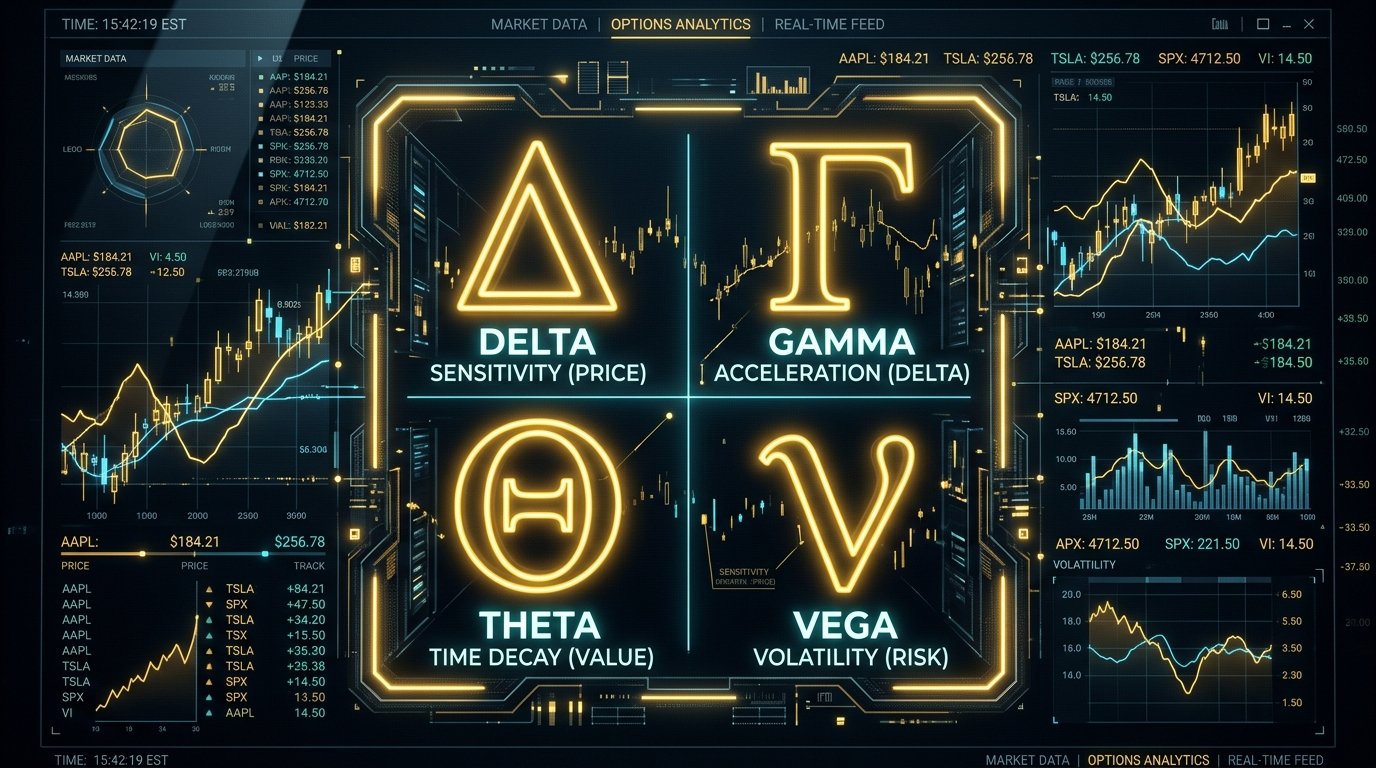
Table of Contents
Understanding the Options Greeks is what separates institutional options traders from retail gamblers. Option contract prices do not move purely based on underlying stock price—they react dynamically to time decay, implied volatility shifts, and directional momentum.
Whether you are buying calls for momentum breakouts or selling option spreads for monthly income, mastering Delta (), Gamma (), Theta (), and Vega () is non-negotiable for consistent risk management.
1. Delta () — Price Sensitivity & Probability Proxy
Delta measures the expected change in option premium for every ₹1 change in the underlying stock or index price.
- Call Option Delta: Ranges between and .
- Put Option Delta: Ranges between and .
- At-The-Money (ATM) options have a Delta of approximately .
- Deep In-The-Money (ITM) options approach a Delta of (behaving like stock futures).
2. Theta () — Time Decay Mechanics
Theta quantifies the daily loss in an option contract’s premium solely due to the passage of time, assuming all other variables remain constant.
The Non-Linear Theta Decay Curve
Theta decay is not linear! Option time value decays slowly when contracts have 60-90 days until expiration (DTE), but accelerates exponentially during the last 30 days before expiration.
- Option Buyers: Target 60-90 DTE to minimize daily Theta decay.
- Option Sellers: Target 30-45 DTE to capture maximum acceleration in Theta decay.
3. Vega () — Volatility Sensitivity & IV Rank
Vega measures how much an option’s premium changes for every 1% change in Implied Volatility (IV).
- Long Options (Calls/Puts): Positive Vega (). Benefit when IV increases (IV expansion).
- Short Options (Credit Spreads/Condors): Negative Vega (). Benefit when IV decreases (IV crush).
| Volatility Metric | High IV Percentile (> 60) | Low IV Percentile (< 20) |
|---|---|---|
| Market Condition | Expensive Options / Fear Spikes | Cheap Options / Market Complacency |
| Optimal Strategy | Credit Spreads, Iron Condors, Strangles | Debit Spreads, Long Straddles, LEAPS |
| Vega Exposure | Short Vega (Profit from IV Crush) | Long Vega (Profit from IV Expansion) |
4. Gamma () — Delta Acceleration & Expiry Risk
Gamma measures the rate of change in Delta per ₹1 movement in the underlying asset. It represents the “acceleration” of option pricing.
- At-The-Money (ATM) options near expiration have the highest Gamma.
- Expiry Day Risk: High Gamma causes option Deltas to jump rapidly from 0.10 to 0.80 on sudden price moves, creating explosive losses for unhedged option sellers.
Advanced Options Greeks Summary Matrix
| Greek | What It Measures | Favorable Market Condition | Recommended Strategy |
|---|---|---|---|
| Delta () | Price Movement | Strong Directional Trend | Vertical Spreads & Futures Hedging |
| Theta () | Time Decay Rate | Rangebound / Slow Market | Iron Condors, Credit Spreads, Covered Calls |
| Vega () | Implied Volatility | Earnings / High Volatility | Short Volatility Spreads / Long Straddles |
| Gamma () | Delta Rate of Change | Low Volatility to Breakout | Long Options / Gamma Hedging |
Related Journal Articles

Short Strangles vs. Iron Condors: Strategic Options Income for Volatile Markets
Compare defined-risk Iron Condors with undefined-risk Short Strangles. Learn how Delta selection, margin management, IV rank, and defensive adjustments dictate options income strategies in Indian markets.

Trading Around a Full-Time Job: A Practical Guide for Working Professionals
You do not need to sit in front of charts all day to trade effectively. Learn swing trading, automated conditional orders, and systematic non-directional options strategies designed for busy careers.